
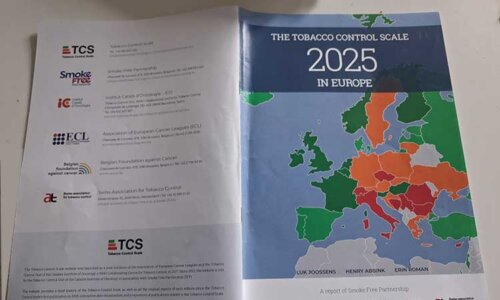
At the ECToH, European Conference on Tobacco or Health, in Milan, fresh copies of The Tobacco Control Scale in Europe, 2025, were distributed. A recurring survey of how countries are succeeding in preventive work to reduce tobacco smoking and the use of heated tobacco products (HTP).
Sweden 24th
The front of the report shows a European map. The worst-performing countries are colored red, followed by countries in orange, and the best countries are various shades of green. Sweden is orange but surrounded by green-colored Nordic neighbors. Of the 37 countries surveyed, Iceland, Norway, Finland, and Denmark are in the top ten, while Sweden is found in 24th place.
– Sweden has previously been good at tobacco prevention, but in recent years they seem to have lost interest, says Luuk Joosens, who has worked with the Tobacco Control Scale since its inception in 2005.
Important criteria that are examined are:
- Taxes to keep prices high
- Restrictions on where you can smoke
- Dissemination of information about the risks of tobacco
- Restrictions on marketing of tobacco products, related products and tobacco companies.
- Health warnings on products
- Help for those who want to quit smoking
Age restrictions have also been added to this year's survey.
Initially, they looked at traditional cigarettes, but since 2018 they have also been looking at heated tobacco products (HTP). There has been discussion about how the new nicotine products should also be included in the survey. But, says Luuk Joosens, it is important not to compromise the credibility of the survey. When the new products are introduced, it must not be at the expense of the quality of the survey.
The survey scores countries. To get a full score, 100 points are required. No country reaches that far, but number one, Ireland, has 80 points, closely followed by the United Kingdom, on 78 points.
Under half of the points
Sweden, with its 47 points, is among the 19 countries that do not reach 50 points. This is a failing grade according to the report.
“These countries must urgently improve their tobacco prevention efforts in the coming years,” the report states.
Sweden loses points for not having neutral packaging and comparatively low taxes on products. Sweden shares the criticism of too low taxes with many countries.
– During 2020 to 2024 there was high inflation, but most countries have not increased the prices of tobacco products in relation to inflation, says Luuk Joosens.
This has strongly contributed to the fact that the results in this report are generally worse than in the previous report. This has never happened before. In previous years, the results have gradually improved.
The UK is one of the countries that gets a commendable pass on taxes. The country can also point to an interesting development when it comes to illegal trade. Opponents of high prices usually warn that it leads to illegal trade. But data from HMRC, the tax authority in the UK, shows that smuggled cigarettes have become fewer at the same time as prices have risen. In 2000, there were 15 billion smuggled cigarettes, by 2023 it was down to two billion.
Taxes but not smuggling
Luke Clancy, professor and director of the TobaccoFree Research Institute Ireland – TFRI, believes that this is consistent with what we know about the illegal trade. It is not driven by price but by whether a country manages to protect itself against criminal networks or not.
– Of course, a price increase can lead to illegal trade. But only if there are illegal networks, otherwise it doesn't happen, says Luke Clancy.
The reason the price is so good for prevention is that the incentive to quit increases. But it is important that it does not hit poor smokers, who fail to quit. They need to be compensated. That says Luke Clancy, professor and director of the TobaccoFree Research Institute Ireland – TFRI. Tobacco Facts has an article about it.
Source:
New Tobacco Control Scale reveals Europe going backwards on tobacco control


