
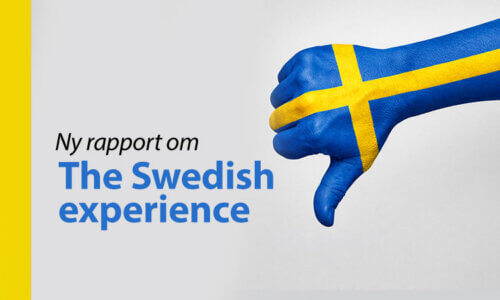
It is common knowledge that Sweden has relatively few smokers. But the question of why is very loaded. The tobacco industry uses Sweden to show how good harm reduction is, offering other nicotine products to reduce smoking.
Snus is said to benefit public health
In Sweden, they claim that snus has led to people smoking. Using “The Swedish experience” as an example, they say that the best way to get people to quit is to make it easy to use other nicotine products, such as snus and e-cigarettes. If sales of these products increase, it doesn’t have to be bad – on the contrary, it can be good for public health.
It is not just the industry that is pushing this line. There are also organizations that support this, as well as politicians. EU parliamentarian Tomas Tobé (M) is an example. He was the Moderate Party's top name ahead of the EU Parliament elections. Standing up for snus was one of the issues he pushed most strongly. The magazine Alkohol & Narkotika asked ahead of the EU elections how he viewed a possible EU ban on white snus. He replied:
We should rather have a system in the EU where white snus is permitted as a basic rule. It would be a huge gain for public health throughout the EU if snus could be allowed to become an alternative for the EU's nearly 100 million smokers.
Prevention reduced smoking
The Swedish Public Health Agency does not share this conclusion. In The Road to a Smoke-Free Sweden , the agency writes that daily cigarette smoking has decreased in Sweden since the 1980s. The decrease coincides with the broad tobacco prevention work that has been carried out during the same time.
The Public Health Agency does not view increased use of other nicotine products positively. Quite the opposite. They write: To reduce the use of one tobacco and nicotine product, we need to work to reduce the use of all products.
Regulation for tobacco and nicotine products that is more similar to the protective legislation that exists for cigarettes would increase protection for children and young people and create better conditions for good and equal health, the Public Health Agency further writes.
The Public Health Agency's analysis is shared by the Smoke Free Partnership. The European network works with tobacco and nicotine prevention at the European level. The Swedish Cancer Society is one of the main organizations and Tobacco Facts is one of the coalition organizations.
“Not snus instead of smoke”
The Smoke Free Partnership has made an evidence-based compilation of "The Swedish experience".
They emphasize that it is not the snus that is the reason for people smoking. The explanation is that Sweden was early in regulating smoking in parallel with support for smokers. The view on smoking changed, smoking became a deviation from the norm.
This is Sweden's proud history, according to the Smoke Free Partnership. But the development that is now taking place in Sweden is not something that other countries should emulate. Tobacco and nicotine use in Sweden is increasing, 28 percent use some tobacco or nicotine product according to statistics from 2024. The increase is mainly linked to young people, especially young women, snorting white snus.
But isn't it better to take snus than to smoke? There is no statistical support for people taking snus instead of smoking. The Swedish Cancer Society has been involved in compiling the Smoke Free Partnership's report. They refer to statistics from the Public Health Agency of Sweden - which show that smoking has decreased regardless of how much people take snus. This is particularly clear when it comes to women. From 2004 to 2024, smoking among women is decreasing. Snus usage remained steadily below 5 percent until 2020. Then snus usage increased to almost 10 percent in 2024. Smoking decreased when there were few women who took snus and smoking continued to decrease when more women took snus. How many people took snus did not affect how many people smoked.
“Regulate all products tightly”
The Smoke Free Partnership wants to show with this report that new nicotine products are not the solution going forward. Instead, we need:
- Strict regulations for all nicotine products – not just cigarettes.
- Strict rules on flavors, marketing and availability to protect young people.
- Harmonization in the Nordic countries and the Baltics so that everyone is pulling in the same direction.
Source:
Smokefreepartnership challenges misinformation about “the Swedish Experience”
Sweden's road to reduced tobacco smoking | The Cancer Foundation
New Swedish tobacco policy hammered out
FACTS:
The report provides background on developments in nicotine products. The reader is also given a description of how dangerous the products are. It also contains statistics and descriptions of how the tobacco industry and other organizations try to influence public health policy.


