

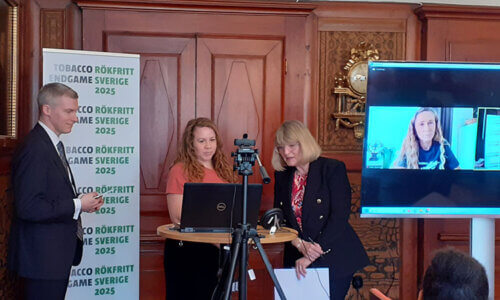
Tobacco Facts and its member organizations are driving the advocacy initiative Tobacco Endgame – Smoke-Free Sweden 2025. The goal is that daily smoking in Sweden by 2025 will be below five percent of the population, a goal with political support. However, in recent years there has been a worrying increase in the number of young people who vape and use white snus. A new goal has therefore been added to Tobacco Endgame – a nicotine-free generation by 2030.
The Tobacco Endgame seminar, held on 23 April, took centre stage with the new target. The focus of the seminar was the WHO theme for World No Tobacco Day on 31 May, “Protecting children and young people from the impact of the tobacco industry”. The audience was physically present at the Swedish Medical Association in Stockholm, but the vast majority followed the seminar via Zoom.
Ann Post, med. dr. and head of the secretariat at Tobaksfakta began. She spoke, among other things, about the two investigations that are now on the table of the Ministry of Social Affairs, from the Public Health Agency and the state investigator Inga-Lill Askersjö. Both investigations conclude that the best thing is to have legislation similar to that for tobacco cigarettes for all tobacco and nicotine products. ( Tobaksfakta has written about this )
Nicotine-free generation
Ann Post reported that Minister of Social Affairs Jakob Forssmed (KD) was asked in the Riksdag how he views an upcoming ANDTS strategy. Forssmed replied that he was awaiting the upcoming investigation.
– Now it exists and we are of course waiting with excitement to see how this will be handled further within politics, said Ann Post.
Ann Post also summarized how the organizations working with Tobacco Endgame believe that public health work should be conducted in the future:
– One is to intensify the work for a Smoke-Free Sweden by 2025 and it is about ensuring that all groups in society are able to reach the goal. We also think that there is reason to consider a decision about a nicotine-free generation. These are discussions that are taking place in several countries. This requires urgent action given the spread that we are seeing of nicotine use, emphasized Ann Post.
Martina Zetterqvist, researcher at CAN – the Swedish Central Association for Alcohol and Drug Information, then presented figures that confirmed that a large increase is taking place. In 2021, 80 million doses of white snus were sold, in 2022 it had risen to 140 million doses. It is among young people that white snus has taken hold. In CAN's latest school survey, 13 percent of ninth graders and 24 percent of high school students, year 2, have used white snus in the last 30 days. In CAN's latest survey of e-cigs, 17 percent of ninth graders and 21 percent of high school students stated that they had vaped in the last month.
– Something has really happened with e-cigarette use, said Martina Zetterqvist.
This can be seen, for example, in the fact that the number of sales points from 2021 to 2022 increased from 1,300 to 2500.
Tobacco Facts chairwoman Lena Sjöberg reacted to how common white snus and e-cigarettes have become among young people. She asked if CAN had seen any similar changes before.
– No, not during my time as an investigator, Martina Zetterqvist replied.
Unknown health consequences
The next speaker was Johanna Andersson, physician and doctoral student, Section of Pharmacology, University of Gothenburg, who, together with researcher Louise Adermark, compiled the state of knowledge regarding the health risks of white snus and e-cigarettes. An important conclusion is that there may be serious risks that are not yet known.
The juice of the e-cigarette contains substances that are approved for consumption, but when heated, toxic compounds are formed. The amount of harmful substances that are formed depends on the type of e-cigarette and e-juice used. The flavorings have in some cases been shown to be cell-damaging and contribute to inflammation. There are more than 15,000 different flavorings, and for many it is not known what happens when inhaled. When it comes to white snus, there are few studies that show their effects.
Lena Sjöberg, Tobacco Facts, finds it strange that these products are being released on the market. She compared it to regulations for pharmaceuticals, which mean that products cannot be sold before the producer has proven that they are not dangerous.
How should politicians deal with the increasing use of white snus and e-cigarettes? Daniel Braw, political expert at Minister of Social Affairs Jacob Forssmed (KD), was on site at the Swedish Medical Association and responded that the government is taking the increasing use seriously. Further measures must be taken to stop the development. He can only answer what that will be after the latest investigation has been submitted for consultation and has been analyzed by politicians.
If politicians choose to follow the investigation, it would mean, as mentioned, treating the new nicotine products more like tobacco cigarettes. The latest political decisions do not go in that direction. This became clear when Daniel Braw spoke about the reduced tax on brown snus and the increased tax on cigarettes.
– The tax on tobacco snus is currently lower than the tax on cigarettes and smoking tobacco, since cigarettes and smoking tobacco together are considered to pose a greater health risk. The government believes that this can help reduce smoking, said Daniel Braw.
Gang crime takes up all resources
Last to speak at the seminar was Anna Haid, coordinator for social sustainability, Uppsala County Administrative Board. Before she spoke about the successful collaboration at the County Administrative Board, she expressed a concern to Daniel Braw: that the work on preventing tobacco and nicotine use is receiving fewer resources when so much is being invested in crime prevention work. Anna Haid said that it is already possible to see that the local resources for working on tobacco prevention have decreased at about the same time as the work on crime prevention has increased, especially in the small municipalities. In the previous ANDTS strategy, tobacco prevention has been linked to crime prevention work, said Anna Haid, but she is afraid that this will not be the case with the new ANDTS strategy. Daniel Braw thanked him for that perspective.
Lena Sjöberg had great understanding for Anna Haid's concerns and hopes that the new ANDTS strategy will also include tobacco and nicotine in crime prevention work.
– We know that there is a ladder of harm where kids start with snus and smoking and then it continues, commented Lena Sjöberg, chairwoman of Tobacco Facts.


