

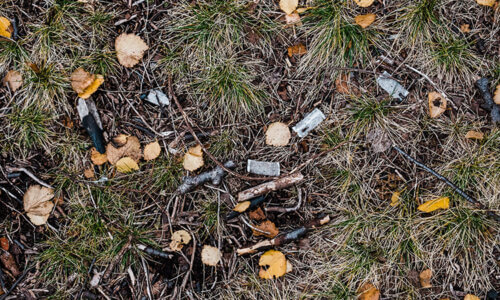
A few weeks ago, Keep Sweden Clean's litter report for littering in 2024 was released. It shows that cigarette butts continue to be the most common litter. In 16 larger urban areas, cigarette butts made up 49% of all litter. This is a decrease. However, snuff litter has increased. In the latest measurement, 21 percent of all litter is snuff (of which 65% is white and 35% is brown).
– The fact that cigarette butts are decreasing is of course positive, but it is still alarming that nicotine litter dominates our city centers, says Johanna Ragnartz, CEO of Keep Sweden Clean, in a press release.
The increasing amount of snus litter is particularly evident in the mountains. One third of everything thrown away in the mountain environment is snus. Snus is the most common type of mountain litter.
Cleaning costs half a billion
According to the Ordinance (2021:1002) on littering fees, producers who release certain disposable products must bear the costs. They must pay a fee for the Swedish Environmental Protection Agency's administration costs and pay for the municipalities' costs of cleaning up the litter. For 2023, the municipalities' costs were 504 million kronor, according to Håll Sverige Rent.
Tobacco companies that produce cigarettes must pay a littering fee. But those that produce snus do not have this obligation. The Swedish Environmental Protection Agency believes that this is wrong. In December 2023, they wrote to the Ministry of Climate and Enterprise that there should also be a fee for snus. The Swedish Environmental Protection Agency has not yet received a response.
Keep Sweden Clean also believes that snus should be covered by legislation.
– So that producers take responsibility when their products become garbage, says Cecilia Liedberg, PR manager, Keep Sweden Clean.
Snuff users can be fined
Snus companies therefore pay nothing, but when it comes to individual responsibility, there is no difference between throwing away a cigarette butt or a snus. Anyone who throws litter on the ground can be fined 800 kronor. Since 2022, this also applies to so-called small litter such as cigarette butts, snus and chewing gum, as Tobacco Facts has previously reported.
But of all those who use snus and smoke or throw other prohibited litter, few are fined. In 2024, 438 fines were issued for littering. This means that very few have to pay for their littering. One in four snus users admits to throwing snus on the ground, according to Keep Sweden Tidy.
Lena Sjöberg, chairwoman of the think tank Tobaksfakta, sighs when she hears how much snus ends up in nature and that snus producers have no liability for payment.
– This is just one of the negative consequences of increasing snus use, and yet another example of politicians having to act. Of course, snus producers have to pay their share of littering and of course we have to have legislation that puts a stop to the alarming increase in snus use, such as flavor bans, exposure bans and reduced nicotine content.
The Ministry of Climate and Industry responds to Tobacco Facts that the letter is still being prepared. The government has not yet made any decision about the snus waste.
FACTS: Products that are/should be subject to a littering fee
A littering fee must be paid for the following products:
Disposable plastic lids for cups, flexible covers, lunch boxes that are disposable plastic products, cups that are disposable plastic products, plastic bottles for drinks that hold less than 0,6 liters (annual fee only, not product fee) Beverage containers other than plastic bottles for drinks that hold less than 0,6 liters, tobacco products with filters, filters, thin plastic carrier bags (annual fee only, not product fee) balloons (from 2025), wet wipes (from 2025)
The Swedish Environmental Protection Agency believes that there should also be a littering fee for the following products:
(listed by occurrence, portioned snus first because it is the most common litter that is not subject to a fee)
Portioned snus, metal caps and lids, plastic straws/wrappers for straws, paper/cardboard straws/wrappers for straws, cigarette packs, deposit boxes, bag closers, very thin plastic carrier bags, snuff boxes, glass packaging, thin plastic carrier bags, plastic bottles for drinks that hold less than 0,6 liters, paper lids for disposable cups, plastic bottles for drinks that hold more than 0,6 liters, beverage containers other than plastic bottles that hold more than 0,6 liters.
